
How to Teach your Baby to Self-Soothe to Sleep (Without any crying)
Author Name: Heidi Holvoet, PhD
With your baby self-soothing to sleep, your life as a parent gets easier again. Your baby can settle without your help at naps and night, fall asleep again when waking, and stay asleep for longer periods without your help.
In this article
Luckily, and contrary to common belief, this does not require any crying or ignoring your baby's needs.
Let's dive in on how to help your baby self-soothing, effectively, and truly without tears.
If your baby won't sleep unless held, nursed, rocked or otherwise helped: this is what you can do.
How to teach your baby to self-soothe without crying
Take these 8 steps to help your baby learn to self-soothe to sleep without tears:
Step 1. Practice at the right age and moment
Starting from 4-6 months and up is easiest - see below for more on timing. This is the age when your baby has matured and developed enough to be able to learn self-settling well.
Step 2. Have an optimal sleep environment
Cozy, soft light, well-aired, pleasant and frankly a bit boring. The ideal sleep-encouraging environment is simple and, same as for us adults, ideally very welcoming and peaceful at the same time.
Step 3. Ensure a peaceful start of the night
Install a good 1 hour wind down and an appropriate bedtime routine. It's an hour to become calm, both in body and mind and surroundings, and for the nervous system to start quieting for the night.
Step 4. Set up clever sleep schedules
A well-adjusted age-appropriate schedule aligns with your baby's sleep patterns. Once you arrive at that best-fit schedule, settling and staying asleep becomes 100 times easier for your baby.
Not only because sleep times become predictable and recognizable, but also physically, in your baby's body and brain, settling and staying asleep for longer stretches is much easier, as if "programmed.
Step 5. Remedy physical and emotional discomforts
Feeling comfortable is important so your baby is actually able to settle well. Review the most common of these infant sleep problems / disturbers here.
Step 6. Use gradual, supported weaning from sleep associations
These include nursing to sleep, rocking, holding or otherwise helping to fall asleep. When done gently and gradually, this can be a smooth and easy transition.
Step 7. Use my progressive no-tears self-soothing techniques
They're designed to help your baby learn to fall asleep witout your help, even if they currently won't sleep unless held.
My techniques allow to go, gradually, from putting baby down deeply asleep (after holding, feeding, rocking or otherwise helping) to going to bed drowsy and eventually even well awake.
Done so cleverly, that it's easy for you, and keeps your baby right comfortable, so there's no need to cry.
Step 8. Give yourselves plenty of slack
This is a crucial step: you're teaching a life skill that will last and it's worth giving it time and get it right
If your little one doesn't seem ready, taking a break of 4-6 days can do incredibly more for your progress than forging ahead would!

To help you achieve faster and consistent results with these 8 steps, we have 2 award-winning programs available, developed by yours truly (Heidi Holvoet) and recommended by parents worldwide:
No-Tears Self Soothing: with this program you'll focus purely on the steps to wean from baby sleep associations (steps 6 and 7 above) and self-settling.
Overcome Frequent Waking (most popular) is fully complete and guides you through all 8 steps above. And it comes with support by me personally for your questions.
Why learning to self-soothe does not require babies to cry
Being able to soothe themselves to sleep is a high level of self-regulation. It's their age, personality, development, health conditions, and sleep environment that determine whether and when your baby can start self-soothing.
Important to note: learning to sleep independently does NOT mean having to let your baby cry.
It's a sad misconception many sources tell new parents; that self-soothing requires "ignoring your baby" and "leaving them to cry until they get it".
That's a myth, that got established in part because even many of the gentle sleep approaches on the market, end up resorting to CIO and ignoring when first attempts fail.
But it's unnecessary.
Self-soothing to sleep does not require your baby to cry. It absolutely shouldn't mean to ignore your baby's needs. Instead, you can teach your baby to self-settle to sleep, with truly gently, truly no-tears techniques.
Teaching baby to self-soothe without crying is 100% doable. (Here at Baby Sleep Advice we do it many times every day! 😊).
We do this with progressive no-tears self-soothing techniques that respect your baby's age, unique personality, and situation.
That way, without forcing, your baby learns this incredibly important life skill. The basis of a lifetime of healthy sleep.
When can babies start to self-soothe?
Between 6 months and 12 months old: unless your baby is a natural self-soother, 6-12 months is when you can realistically expect them to start self-soothing, really and consistently.
Can a newborn self-soothe?
Yes and No. Many newborns tend to settle easily in their first weeks. As a new parent this is wonderful and impressive to witness.
But at this age it's merely part of their normal sleep patterns and not yet the actual self-regulatory behavior. In normal child development, this happens only many months later.
Please don't feel discouraged if you hear other moms report that their newborn baby calm themselves down and doze off alone. It happens, but it's definitely not the standard that "has" to happen now.
All babies are unique though so as always, there is a huge variation to these average numbers.
That means that your baby might start start showing self-soothing behaviors at 4 months old, while many older babies need to learn still too. This can happen at 8 months, 10 months, 1 year old, 2+3 year old and anything in between.
The main thing to realize is to view self-soothing to sleep is a skill to learn, just like learning to walk and talk.
And just like with learning to walk and talk, babies learn best without forcing things too early. And we wouldn't expect them to walk or talk before they're developmentally ready either.

When to start practicing self-soothing techniques
For most families, you start ideally when your baby:
- is 4 months or older,
- is developmentally ready (this can be at younger or older ages from the above)
- is not currently sick, unwell or more anxious than usual
- there are no big changes happening (a big trip, a new sibling just arrived, starting daycare, etc.)
- you yourself are ready i.e. you feel supported and relatively relaxed
Don't worry if your current situation is different from this "ideal".
If you need your little one to settle independently NOW. To stop feeding, holding, rocking or otherwise helping baby sleep NOW, we've got you.
We can adjust your sleep plan so you can practice self-soothing even if things don't feel 100% right now:
You can DIY this inside the Overcome Frequent Waking program with group support by me and the team
or otherwise contact me for a 1:1 consult).
And we have super gentle super soft practices for newborn babies up to 3 month olds where we gently encourage self-soothing behaviors. Important! This has nothing to do with forcing or any form of CIO!
And we won't have your newborn sleep independently (they don't have to yet) but helps tremendously with being calm, and getting more rest for yourself.
Why is self-soothing important?
Self-soothing to sleep is important because no one (babies and adults) ever really sleeps through the night.
Our sleep comes in cycles : we go through the different stages of sleep several times a night. In-between cycles, there is a brief awake moment.
The skill to settle ourselves helps us go straight back to sleep without waking up completely.
Babies who cannot go back to sleep easily and independently yet will wake up completely at that moment, need your attention and possibly cry.
It's also helpful for falling asleep without nursing, holding, rocking or otherwise helped by you.
Self-soothing is part of an array of self-regulation mechanisms that all infants discover naturally and/or learn.

It doesn't only serve to help baby calm down for sleep, falling asleep or going back to sleep but in itself helps anyone cope with demands such as emotions and reactions to what is happening in our environment.
Being able to settle themselves allows babies to feel safe and secure in their environment, and start to build confidence and independence.
It's good to note that babies self-soothing independently isn't the only possibility.
Calling for you, needing your help, trying to nurse or bottle feed are in fact clever ways your baby tries out, to find calm, and settle.
It's not easy for them, is what I'm trying to say: they're not trying to trick you into staying close to them, just trying to do whatever helps.
What if my baby can't self-soothe to sleep?
It's perfectly normal and absolutely not wrong or harmful in any way if your baby struggles to sleep independently just now. You're very welcome to contact me anytime if you're unsure.
As long as you're up for it and you feel OK about helping your baby fall asleep, it's OK.
More than OK even! Because by helping your baby settle:
- you ensure more sleep for the whole family
- you help keep night wakings short which is important to develop health sleep patterns
- you provide some of the most powerful positive baby sleep associations: you, your presence, your reassurance, your love: there is no better way to nurture a healthy relationship with sleep that will last all through baby's life.
So, always keep in mind that:
You can get your baby to self-soothe but you don't have to.
You can, when you're both ready, or if you're not ready but need it for your own well-being and mental health. You can, and will make progress with all the info in this article.
But you don't have to. Please don't feel pressured into it by the media or other moms whose babies are "settling perfectly" (they usually aren't).
There's no rush, it'll be time when you decide it's time. And we're here for you if you can use some help.
Teaching your baby to self-soothe without pacifier
Many parents wonder if it's possible for a baby to soothe themselves without a pacifier. It is possible, and how depends on which of these two situations you're in:
1. If your baby falls asleep easily with a pacifier
If a paci or dummy helps your baby sleep, my advice is to allow it. When not over-used during awake time but mainly at nap and bedtime, a pacifier is a completely legit sleep aid.
We know from research that it can help protect against SIDS [1].
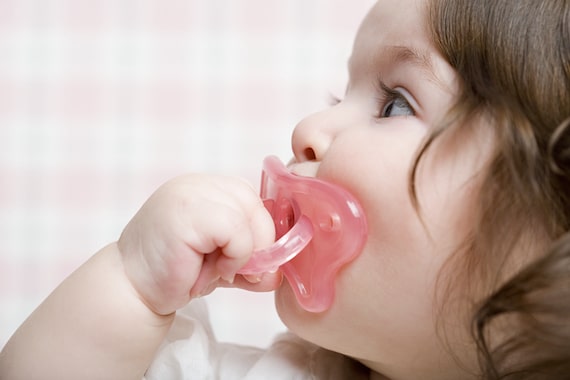
Also, pediatric dentists see no problem with paci use until 2-4 years of age with the AAP assuring that at 3 years old, not sooner, intervention is needed if a child has not weaned themselves from the pacifier.
Therefore, if the pacifier helps your little girl or boy settle and sleep more independently, don't wean from it just yet.
Instead, use it to make your baby's self-soothing practice easier.
And to avoid your baby frequently waking at night due to losing the pacifier, my Play2Sleep paci games (free download) help take care of that.
2. If your baby doesn't fall asleep with a pacifier, or never takes one
Not taking a paci but using thumb or fingers comforts many babies. Some will use a soft toy or blankie or a similar transitional object.
As long as these objects are safe - i.e. your baby is old enough and the toy safe enough so as not to increase the risk of SIDS, these alternatives are OK.
Your baby may use you as a human pacifier. Nothing wrong with that as long as you're OK with it yourself and it doesn't worsen your sleep deprivation.
Once you want to wean from nursing to sleep and for comfort, you'll find my Gentle Unlatch Technique most effective (explained and demonstrated in detail inside Overcome Frequent Waking). It respectfully takes into account your baby's needs, as well as your own.
Extra aids
- A good wind-down period and bedtime routine: Winding down before bed (low lights, soft voices, low activity) helps calm the nervous system. This happens best in the hour before the bedtime or sleep routine.
A bedtime routine helps your baby recognize bedtime signals and physically helps the body to get ready for the night.
Keeping nights and interaction low at night is crucial to keep her ready to go on sleeping without waking up completely.
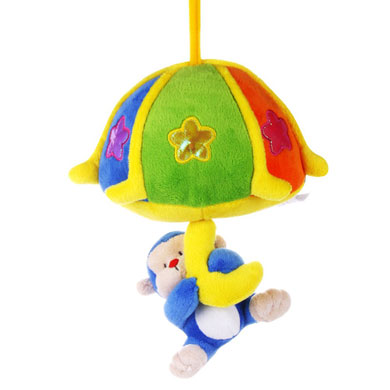
- A musical mobile or toy: SAFELY attached so it cannot be pulled into the crib, a musical mobile helps many babies sleep extremely well.
If you can find one that attaches to the side, and that baby can operate (for example by pulling a string - as in the picture), WITHOUT BEING ABLE TO PULL IT INTO THE CRIB, that can work wonderfully well.
As they grow, your little girl or boy will learn to switch it on themselves. Once they're used to hearing it at bedtime, it can work wonders for self-soothing! - White noise: by blocking out background noises, white noise machines help some babies feel calmer and less disturbed when trying to settle.
- Your presence: for some babies, knowing that you are nearby (this can be sitting next to the crib, or walking around her room, but also just be in the bathroom or down the hallway) may be enough reassurance to allow self soothing.
Will my self-soothing baby sleep through the night consistently?
Babies who can comfortably settle without your help can be put to bed drowsy or fully awake.
If they fell asleep this way without turmoil - so without crying, anxiety, or in any way being upset - they have the best chance at long periods of healthy, uninterrupted rest. Of being able to go back to sleep when briefly waking. Of feeling confident, cozy and content.
And indeed, this gives the best chances of sleeping through the night consistently.
Sleep training that uses harsh methods like CIO or similar are disadvised. They increase stress levels and anxiety for yourself and your child and they don't foster a healthy lifetime relationship with night time rest.
They're rooted in some of the unrealistic expectations society inflicts, instead of nurturing your and your little one's needs first and foremost.
Instead, with the 8 steps above, you can effectively help your baby learn to self-soothe the truly gentle, truly no-tears way.
Finally, dear parent, I know so well how rough this period you're going through can be. Please know that the team and I are always here for you and so never hesitate to get in touch.
Bibliography and Resources
[1] Sleep-Related Infant Deaths: Updated 2022 Recommendations for Reducing Infant Deaths in the Sleep Environment Rachel Y. Moon, MD, FAAP; Rebecca F. Carlin, MD, FAAP; Ivan Hand, MD, FAAP; June 2022. Pediatrics (2022) 150 (1): e2022057990. https://doi.org/10.1542/peds.2022-057990
Article Author: Heidi Holvoet, PhD - Founder, senior sleep consultant

Heidi Holvoet, PhD, is the founder of the Baby Sleep Advice website and movement, an award-winning author, baby & toddler sleep consultant with 15+ years experience as well as a certified lactation counselor.
Over the years, Heidi has received several awards inluding a Mom's Choice Award (MCA) and National Parenting Awards (NAPPA) for her Baby Sleep Advice website, programs and books. Also, Baby Sleep Advice was awarded "Most Trusted Infant's Sleep Solutions Company 2023" in the Benelux Enterprise Awards 2023.
Heidi continually conducts personal research and participates in continued education and in that way stays up to date with current scientific and pyschosocial infant care.

She is also a member of the Association of Professional Sleep Consultants of which she was one of the earliest contributors. She obtained her PhD degree in physics at the University of Ghent in Belgium.
Heidi is passionate about helping babies and their parents sleep more and better, with her trademark approach that has been proven and praised time and again by parents worldwide to be effective and truly no-tears. Respect for you as a parent and your baby, is at the heart of Heidi's warm and kind support. Her approach always keeps in mind a baby's needs and abilities at any given age, is based on pediatric science and the most up to date knowledge in infant care and sleep science.
As well as the award-winning baby sleep programs, Heidi offers popular 1:1 consults and easy-access 30-minute SOS Sleep sessions.

Baby waking every hour?
by Heidi Holvoet, PhD

A Bedtime Routine: Settling To Sleep Like A Charm
by Heidi Holvoet, PhD

Separation Anxiety
by Heidi Holvoet, PhD

Colic
by Heidi Holvoet, PhD

Why does my baby wake up every hour?
by Heidi Holvoet, PhD