
Obstructive Sleep Apnea In Children
Author Name: Heidi Holvoet, PhD
Is your child snoring at night? Mouth breathing when sleeping?
Sweating heavily? Moody, cranky or showing behavioral
problems during the day? These are symptoms of sleep apnea in children
that may need medical attention.
Obstructive
Sleep Apnea
(OSA) is the single most common type.
An affected child will have
frequent airway
blockages during naps or nights: she will stop breathing for several moments,
then wake up briefly, gasping for breath.
This can occur up to tens of times each night, or during naps.
About 1-3% of children (between 2 and 18 years old) will have a
form of it at some point, which is quite a large number. Between 2 and
6
years old is the peak age, but
sleep
apnea in babies
also occurs.
Needless to say that it's a disorder that prevents good
quality naps and nights. It also brings along serious health problems and may be
dangerous. That's why
diagnosis
and
appropriate
treatment
is so important.
But sadly, it all too often goes
unnoticed
. Why?
Because the symptoms are not always crystal clear. Let's have a look.
Worried?
Questions? Don't hesitate to
Ask
me
Signs of Sleep Apnea in Children
There are
important
differences between the symptoms in children and in
adults
[1]
.
In adults already it goes undiagnosed all too often, but the
symptoms in children can be even more hidden, making a quick and correct diagnosis even
harder.
To
start with, you
may not
notice that your little one wakes up
tens
of times each night. She may wake up briefly, catch her breath, and go
on sleeping.
Even though she gets very poor nights in this way, she
may not even
seem extremely tired
during the day (the main difference
with the symptoms in adults!). On the contrary, a sleep apnea child
may be
overly active
during the day. Or be quite moody or show
behavioral problems.
Read more about the
signs and symptoms
in children (including a complete check list).
Diagnosis in Children
As soon as you have any hint that your child may suffer from a form of
apnea, see your doctor of paediatrician for a check-up.
The best
diagnosis will be done by a specialized
pediatric sleep center
.
A
dedicated study
and/or
polysomnography
will be used for the OSA diagnosis.
A
polysomnography monitors sounds (snoring and gasping for breath) but
also breathing, brain waves, muscle tension and oxygen levels. It's an
overnight test which is either done at the pediatric center or at home with
a home monitoring kit.
Treatments for Sleep Apnea in Children
The main cause in young children is relatively
large tonsils
and adenoids (those glands at the back of the throat and
behind the nose).
The most effective classic medical treatment then is the removal of
those through a so-called
Tonsillectomy
and Adenoidectomy
(T&A).
Alternatively a
CPAP
(Continuous Positive Airway Pressure) machine can be used.
For more details on this see the
apnea solutions overview
.
Sleep Apnea
Worried? Questions? Ask me
Article Author: Heidi Holvoet, PhD - Founder, senior sleep consultant
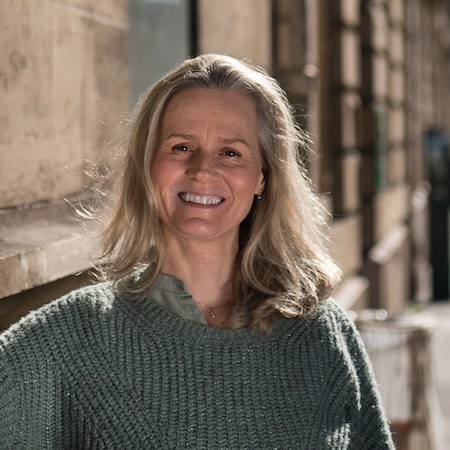
Heidi Holvoet, PhD, is the founder of the Baby Sleep Advice website and movement, an award-winning author, baby & toddler sleep consultant with 17+ years experience as well as a certified lactation counselor.
Over the years, Heidi has received several awards inluding a Mom's Choice Award (MCA) and National Parenting Awards (NAPPA) for her Baby Sleep Advice website, programs and books. Also, Baby Sleep Advice was awarded "Most Trusted Infant's Sleep Solutions Company 2023" in the Benelux Enterprise Awards 2023.
Heidi continually conducts personal research and participates in continued education and in that way stays up to date with current scientific and pyschosocial infant care.
She is also a member of the Association of Professional Sleep Consultants of which she was one of the earliest contributors. She obtained her PhD degree in physics at the University of Ghent in Belgium.
Heidi is passionate about helping babies and their parents sleep more and better, with her trademark holistic and truly-no-tears approach that has been proven and praised time and again by parents worldwide to be effective and truly no-tears. Respect for you as a parent and your baby, is at the heart of Heidi's warm and kind support. Her approach always keeps in mind a baby's needs and abilities at any given age, is based on pediatric science and the most up to date knowledge in infant care and sleep science.
As well as the award-winning baby sleep programs, Heidi offers popular 1:1 consults and easy-access 30-minute SOS Sleep sessions.
Back to the
Sleep disorder overview
Resources
[1] Children's Sleep Apnea on Sleepapnea.org.
Baby waking every hour?
by Heidi Holvoet, PhD
Sleep schedules by age
by Heidi Holvoet, PhD
Separation Anxiety
by Heidi Holvoet, PhD
Crib safety guidelines
by Heidi Holvoet, PhD
Why does my baby wake up every hour?
by Heidi Holvoet, PhD
'%3e%3cg id='Final-Copy-2_2_' transform='translate(1275.000000, 200.000000)'%3e%3cpath class='st0' d='M7.4,12.8h6.8l3.1-11.6H7.4C4.2,1.2,1.6,3.8,1.6,7S4.2,12.8,7.4,12.8z'/%3e%3c/g%3e%3c/g%3e%3c/g%3e%3cg id='final---dec.11-2020'%3e%3cg id='_x30_208-our-toggle' transform='translate(-1275.000000, -200.000000)'%3e%3cg id='Final-Copy-2' transform='translate(1275.000000, 200.000000)'%3e%3cpath class='st1' d='M22.6,0H7.4c-3.9,0-7,3.1-7,7s3.1,7,7,7h15.2c3.9,0,7-3.1,7-7S26.4,0,22.6,0z M1.6,7c0-3.2,2.6-5.8,5.8-5.8 h9.9l-3.1,11.6H7.4C4.2,12.8,1.6,10.2,1.6,7z'/%3e%3cpath id='x' class='st2' d='M24.6,4c0.2,0.2,0.2,0.6,0,0.8l0,0L22.5,7l2.2,2.2c0.2,0.2,0.2,0.6,0,0.8c-0.2,0.2-0.6,0.2-0.8,0 l0,0l-2.2-2.2L19.5,10c-0.2,0.2-0.6,0.2-0.8,0c-0.2-0.2-0.2-0.6,0-0.8l0,0L20.8,7l-2.2-2.2c-0.2-0.2-0.2-0.6,0-0.8 c0.2-0.2,0.6-0.2,0.8,0l0,0l2.2,2.2L23.8,4C24,3.8,24.4,3.8,24.6,4z'/%3e%3cpath id='y' class='st3' d='M12.7,4.1c0.2,0.2,0.3,0.6,0.1,0.8l0,0L8.6,9.8C8.5,9.9,8.4,10,8.3,10c-0.2,0.1-0.5,0.1-0.7-0.1l0,0 L5.4,7.7c-0.2-0.2-0.2-0.6,0-0.8c0.2-0.2,0.6-0.2,0.8,0l0,0L8,8.6l3.8-4.5C12,3.9,12.4,3.9,12.7,4.1z'/%3e%3c/g%3e%3c/g%3e%3c/g%3e%3c/g%3e%3c/svg%3e) Your Privacy Choices
Your Privacy Choices