Sleep Apnea Solutions for Babies, Toddlers and Children
Author Name: Heidi Holvoet, PhD
Which
sleep apnea solutions can
help
your baby, toddler or child
? When is a
breathing monitor, medication, tonsil surgery, or a CPAP
device advised?
In all cases, your doctor, preferably a
pediatric sleep
specialist, will determine which remedies
best fit your child and his condition. The
overview below
gives
the
most common and successful solutions for kids of all
ages used today. Use them as a step-up to discuss them with your doctor.
Sleep Apnea Solutions for Babies
Sleep
apnea in infants
under 1 year old is usually
Central
Sleep Apnea
,
when a failing brain signal causes the typical breathing pauses.
That means that
there is no physical blockage of the airways (which is the case with the so-called
obstructive type, typical in older children, see below).
The first step is usually
a
breathing or sleep apnea monitor
.
While asleep your baby is connected to the monitor. It records her
breathing and heart rate and warns you as soon as they reach critical
values.
Alternatively, or at the same time, your pediatrician may prescribe
medication
.
Since the breathing pauses are due to a failed
brain signal, the medication will work on enhancing or improving that
signal.
A
CPAP
mask
is rarely prescribed for babies. Especially since with young babies no
physical blocking of the airways is involved a mask most often do not
bring much relief.
However, some pediatricians do prescribe it, for example when
your baby's sleep apnea is of the obstructive or mixed type.
Sleep Apnea Solutions for Toddlers and Older Children
Obstructive Sleep Apnea is the most common type above 2 years old.
-
The peak age for
sleep
apnea in kids
is between 2 and 6 years old. This is an age where a child's tonsils
and adenoids can typically be quite large compared to their throats and
airways. That is the reason why tonsil surgery is often very effective.
The operation, called T&A surgery or Tonsillectomy and Adenoidectomy involves removing both the Tonsils (glands at the back of the throat) and the Adenoids (at the back of the nose).
This operation is not without risks. It'is a serious surgical procedure. It will of course be avoided when diagnosis is uncertain or if your child is at risk of serious complications. -
A
CPAP device
is
another possible solution, advised when the T&A surgery is
dis advised or does not help.
CPAP is for C ontinuous P ositive A irway P ressure.
The CPAP machine compresses the air in the room and sends it to a mask through a hose. The mask covers the nose. the high-pressure air keeps the airways open, avoiding the sleep apnea breathing pauses.
Although CPAP can be very effective, not all experts agree on its use for youngsters. To start with, it is not comfortable to sleep with a mask, near a machine. Use of CPAP will of course only be done in strong agreement and cooperation between you and your child's doctor. - In some cases, the cause can be found in obesity. Losing weight is then a first step towards any treatment. Also other health issues will benefit from losing weight.
Sleep Apnea
Worried? Questions? Ask me
Article Author: Heidi Holvoet, PhD - Founder, senior sleep consultant
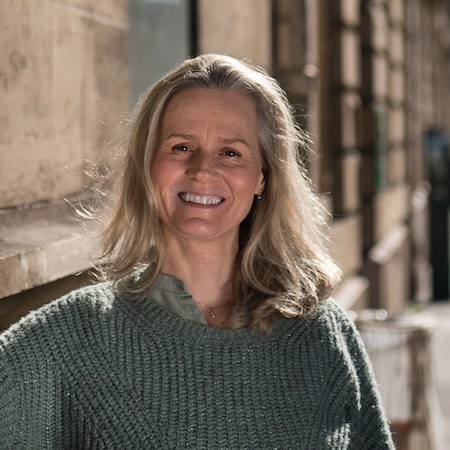
Heidi Holvoet, PhD, is the founder of the Baby Sleep Advice website and movement, an award-winning author, baby & toddler sleep consultant with 17+ years experience as well as a certified lactation counselor.
Over the years, Heidi has received several awards inluding a Mom's Choice Award (MCA) and National Parenting Awards (NAPPA) for her Baby Sleep Advice website, programs and books. Also, Baby Sleep Advice was awarded "Most Trusted Infant's Sleep Solutions Company 2023" in the Benelux Enterprise Awards 2023.
Heidi continually conducts personal research and participates in continued education and in that way stays up to date with current scientific and pyschosocial infant care.
She is also a member of the Association of Professional Sleep Consultants of which she was one of the earliest contributors. She obtained her PhD degree in physics at the University of Ghent in Belgium.
Heidi is passionate about helping babies and their parents sleep more and better, with her trademark holistic and truly-no-tears approach that has been proven and praised time and again by parents worldwide to be effective and truly no-tears. Respect for you as a parent and your baby, is at the heart of Heidi's warm and kind support. Her approach always keeps in mind a baby's needs and abilities at any given age, is based on pediatric science and the most up to date knowledge in infant care and sleep science.
As well as the award-winning baby sleep programs, Heidi offers popular 1:1 consults and easy-access 30-minute SOS Sleep sessions.
Back to the
Sleep disorder overview

Baby waking every hour?
by Heidi Holvoet, PhD
Sleep schedules by age
by Heidi Holvoet, PhD
Separation Anxiety
by Heidi Holvoet, PhD

Crib safety guidelines
by Heidi Holvoet, PhD

Why does my baby wake up every hour?
by Heidi Holvoet, PhD
'%3e%3cg id='Final-Copy-2_2_' transform='translate(1275.000000, 200.000000)'%3e%3cpath class='st0' d='M7.4,12.8h6.8l3.1-11.6H7.4C4.2,1.2,1.6,3.8,1.6,7S4.2,12.8,7.4,12.8z'/%3e%3c/g%3e%3c/g%3e%3c/g%3e%3cg id='final---dec.11-2020'%3e%3cg id='_x30_208-our-toggle' transform='translate(-1275.000000, -200.000000)'%3e%3cg id='Final-Copy-2' transform='translate(1275.000000, 200.000000)'%3e%3cpath class='st1' d='M22.6,0H7.4c-3.9,0-7,3.1-7,7s3.1,7,7,7h15.2c3.9,0,7-3.1,7-7S26.4,0,22.6,0z M1.6,7c0-3.2,2.6-5.8,5.8-5.8 h9.9l-3.1,11.6H7.4C4.2,12.8,1.6,10.2,1.6,7z'/%3e%3cpath id='x' class='st2' d='M24.6,4c0.2,0.2,0.2,0.6,0,0.8l0,0L22.5,7l2.2,2.2c0.2,0.2,0.2,0.6,0,0.8c-0.2,0.2-0.6,0.2-0.8,0 l0,0l-2.2-2.2L19.5,10c-0.2,0.2-0.6,0.2-0.8,0c-0.2-0.2-0.2-0.6,0-0.8l0,0L20.8,7l-2.2-2.2c-0.2-0.2-0.2-0.6,0-0.8 c0.2-0.2,0.6-0.2,0.8,0l0,0l2.2,2.2L23.8,4C24,3.8,24.4,3.8,24.6,4z'/%3e%3cpath id='y' class='st3' d='M12.7,4.1c0.2,0.2,0.3,0.6,0.1,0.8l0,0L8.6,9.8C8.5,9.9,8.4,10,8.3,10c-0.2,0.1-0.5,0.1-0.7-0.1l0,0 L5.4,7.7c-0.2-0.2-0.2-0.6,0-0.8c0.2-0.2,0.6-0.2,0.8,0l0,0L8,8.6l3.8-4.5C12,3.9,12.4,3.9,12.7,4.1z'/%3e%3c/g%3e%3c/g%3e%3c/g%3e%3c/g%3e%3c/svg%3e) Your Privacy Choices
Your Privacy Choices