
Sleep Deprivation Effects and How to Tackle Them
Author Name: Heidi Holvoet, PhD
99% of parents experience sleep deprivation in their baby's first year, and often beyond. Broken nights are of course the top cause and leave many moms and dads feeling tired constantly.

And it's hard, I know. But we can work on it. So let's take a look at what we can do to improve your own sleep.
Understanding Sleep Deprivation Effects
From chaotic newborn sleeping patterns to teething and tantrum sleep
scenes, our sleep is so easily disturbed.
Even a few broken nights can make you feel tired all day,
have less energy, you may find it harder to concentrate and you
often feel a bit sad.
The good part is that our bodies,
especially women's, are able to
adjust rather well and to keep going in spite of the lack of sleep. But there are limits and it's important to keep taking good care of yourself.
A few things you can do:
- Remember, and remind yourself, that things will get better . After the chaotic first weeks and months, your baby will start sleeping more and better, and so will you! It may look like a dream far away, but better times are ahead! This may not be a big help at the toughest times but it is a fact to hang on to.
- Realize that it is absolutely alright to feel a bit sad or emotional . Knowing that it is the lack of sleep doing this, and not you not being up to it, gives you the confidence to keep going. If you feel it's all too overwhelming and you can't take another sleepless night, contact me , I'm here to help!
A cure for Sleep Deprivation Effects?
It sounds all too easy, but
sleep
is of course
the single
best cure for sleep deprivation
.
Unfortunately, getting more sleep is often
easier said than done
when you have a newborn baby, maybe older children, household and work
activities to be dealt with too.
So, What can you do?
Accept help. Don't hesitate to ask and accept
help
from your partner, family or friends
. Many moms feel
ashamed or guilty to do this, but there is no need to!! Having a young
baby is not easy and it's perfectly alright to get help.
Remember how it is in today's society that we are expected to do
so many things alone. In the
old
days, all young
moms had mothers, sisters, aunts, etc. who were there all the time to help out.

If you can find someone to look after your baby for an hour, an
afternoon or maybe a night: don't hesitate!
And take that time to
recharge
your batteries
. It's amazing what a few hours of sleep or just some relaxing can do.
You can feel so much stronger again after that.
Besides accepting help, the following will also help you:
- Sleep well : just like for your baby, a regular sleep schedule and a bedtime routine helps adults sleep better too. Within what's possible with baby's sleep, try to go to sleep and wake up at regular times when possible.
- Healthy eating and drinking : drink plenty of water and eat healthy meals with lots of fruit and vegetables. Avoid alcohol, coffee and tea in the afternoon and evening as they may make you sleep worse. Herbal tea, a glass of warm milk, yogurt, a banana, etc. are all good.
- Indulge in a bit of, preferably dark, chocolate. Chocolate is known to improve your mood. Eat it early on in the day as it can also be a stimulant.
- Do something you lOve whenever you have a moment (whether it's an hour or just 5 minutes!). Do something you really like (put on your favorite music, watch a movie, go out for a walk, etc.) or try some simple relaxation techniques .
The effects of sleep deprivtion can be really daunting and can make you feel really bad, even desperate. Remember to keep taking good care of yourself and seek help, start with sending me a message here if you like. Hang in there!
Article Author: Heidi Holvoet, PhD - Founder, senior sleep consultant
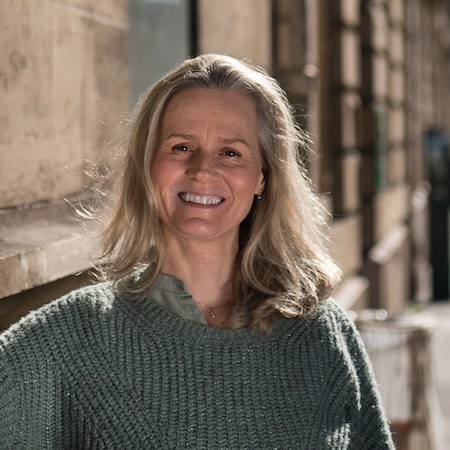
Heidi Holvoet, PhD, is the founder of the Baby Sleep Advice website and movement, an award-winning author, baby & toddler sleep consultant with 17+ years experience as well as a certified lactation counselor.
Over the years, Heidi has received several awards inluding a Mom's Choice Award (MCA) and National Parenting Awards (NAPPA) for her Baby Sleep Advice website, programs and books. Also, Baby Sleep Advice was awarded "Most Trusted Infant's Sleep Solutions Company 2023" in the Benelux Enterprise Awards 2023.
Heidi continually conducts personal research and participates in continued education and in that way stays up to date with current scientific and pyschosocial infant care.
She is also a member of the Association of Professional Sleep Consultants of which she was one of the earliest contributors. She obtained her PhD degree in physics at the University of Ghent in Belgium.
Heidi is passionate about helping babies and their parents sleep more and better, with her trademark holistic and truly-no-tears approach that has been proven and praised time and again by parents worldwide to be effective and truly no-tears. Respect for you as a parent and your baby, is at the heart of Heidi's warm and kind support. Her approach always keeps in mind a baby's needs and abilities at any given age, is based on pediatric science and the most up to date knowledge in infant care and sleep science.
As well as the award-winning baby sleep programs, Heidi offers popular 1:1 consults and easy-access 30-minute SOS Sleep sessions.
Resources
[1] Sleep deprivation or postnatal depression in later infancy: Separating the chicken from the egg Armstrong et al. Journal of Paediatrics and Child Health , Volume 34, Number 3, June 1998 , pp. 260-262(3).

Baby waking every hour?
by Heidi Holvoet, PhD
Sleep schedules by age
by Heidi Holvoet, PhD

Separation Anxiety
by Heidi Holvoet, PhD
Crib safety guidelines
by Heidi Holvoet, PhD

Why does my baby wake up every hour?
by Heidi Holvoet, PhD
'%3e%3cg id='Final-Copy-2_2_' transform='translate(1275.000000, 200.000000)'%3e%3cpath class='st0' d='M7.4,12.8h6.8l3.1-11.6H7.4C4.2,1.2,1.6,3.8,1.6,7S4.2,12.8,7.4,12.8z'/%3e%3c/g%3e%3c/g%3e%3c/g%3e%3cg id='final---dec.11-2020'%3e%3cg id='_x30_208-our-toggle' transform='translate(-1275.000000, -200.000000)'%3e%3cg id='Final-Copy-2' transform='translate(1275.000000, 200.000000)'%3e%3cpath class='st1' d='M22.6,0H7.4c-3.9,0-7,3.1-7,7s3.1,7,7,7h15.2c3.9,0,7-3.1,7-7S26.4,0,22.6,0z M1.6,7c0-3.2,2.6-5.8,5.8-5.8 h9.9l-3.1,11.6H7.4C4.2,12.8,1.6,10.2,1.6,7z'/%3e%3cpath id='x' class='st2' d='M24.6,4c0.2,0.2,0.2,0.6,0,0.8l0,0L22.5,7l2.2,2.2c0.2,0.2,0.2,0.6,0,0.8c-0.2,0.2-0.6,0.2-0.8,0 l0,0l-2.2-2.2L19.5,10c-0.2,0.2-0.6,0.2-0.8,0c-0.2-0.2-0.2-0.6,0-0.8l0,0L20.8,7l-2.2-2.2c-0.2-0.2-0.2-0.6,0-0.8 c0.2-0.2,0.6-0.2,0.8,0l0,0l2.2,2.2L23.8,4C24,3.8,24.4,3.8,24.6,4z'/%3e%3cpath id='y' class='st3' d='M12.7,4.1c0.2,0.2,0.3,0.6,0.1,0.8l0,0L8.6,9.8C8.5,9.9,8.4,10,8.3,10c-0.2,0.1-0.5,0.1-0.7-0.1l0,0 L5.4,7.7c-0.2-0.2-0.2-0.6,0-0.8c0.2-0.2,0.6-0.2,0.8,0l0,0L8,8.6l3.8-4.5C12,3.9,12.4,3.9,12.7,4.1z'/%3e%3c/g%3e%3c/g%3e%3c/g%3e%3c/g%3e%3c/svg%3e) Your Privacy Choices
Your Privacy Choices