
Ear and Temporal Thermometers
Author Name: Heidi Holvoet, PhD
Both a
temporal thermometer
(forehead) and an
ear
thermometer
are
quick &
easy to measure baby's
temperature - especially if you need it while she sleeps.
You know those moments, when your she's had a fever during the day and
while she's sleeping you want to check if it's still there or
got better ... Or when baby's cranky and fussy during the day and
too restless to get a decent regular temperature (rectal or under arm).
Or you're on the road ... that's when such a quick indication can be a
godsend (!).
Let's have a look at
the different types and what to look out for when choosing one.
Temporal Thermometer

Pro:
No-hassle and quick. Good indication of body temperature.
Con:
May need to average 2-3 measurements.
A forehead or temporal thermometer measures body temperature at the
forehead
.
The same place
where us moms and dads place our lips to get a first indication of
fever/no
fever ...
How to use: with most models, you
hold the
head
against your
baby's forehead and gently swipe it sideways over the eyebrow and
towards the hairline.
Most babies and toddlers don't mind this at all
and won't even wake up it you want to measure while sleeping.
It's best to wipe dry baby's forehead before measuring to
avoid wrong readings, especially if it's hot or if she's a bit sweaty.
For young babies (under 1 year old, some say 3 years), results may not
be 100% reliable. Many have long shouted that this type of measurement
is totally unusable. But the new models are getting better and better
and are widely used by doctors and in hospitals, because indeed there
is a lot of value in getting a fast relative temperature reading.
Sadly, really cheap ones just don't offer enough quality so you need to
spend a little.
The
Exergen
Temporal Thermometer
is very reasonably priced though and
gives good results.
It does take a bit of practice to do the move correctly. The
measurement may vary with how exactly you swipe. So it's a good idea to
test a couple of times before starting to rely on the results.
Take your temporal thermometer to the doctor on your next visit to
compare your results to his in a test measurement.
Remark: there are also
temple
thermometers
(no swiping, just hold against
temple
)Â on
the market but to date I have not found a sufficiently reliable
one to recommend. Please let me know if you have experience - good or
bad.
Ear Thermometer
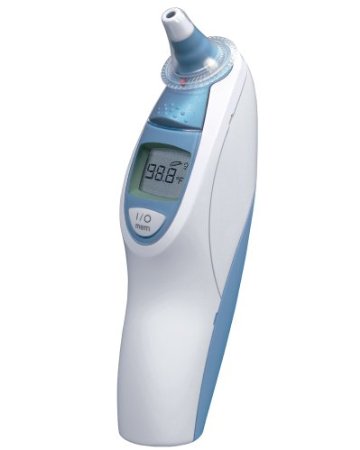
Pro:
Quick indication of body temperature.
Con:
Must insert precisely. Not with ear infection.
To measure temperature with an ear thermometer, you have to insert its
head
into the ear
entrance. To do this correctly you have to
pull
the ear to
open and straighten the
ear
canal
.
That's the main drawback of this type of thermometer: to do it
correctly can be a little uncomfortable for your child. It'll be
impossible when he has an ear infection. And if you don't insert
correctly, the measurement will not be precise.
But it's quite doable. With just a bit of practice you'll soon get the
hang of it. A good quality
ear thermometer like the
Braun
Thermoscan
gives good
results.
Don't bother to shop (and pay!) for the fastest "1 second" gadget.
Good
quality may take just a few seconds longer, but those few
moments won't bother your child that much.
And those moments are worth the
wait
because you get a better reading.
Mind that for really young babies
results may not be very reliable. As your child grows though, the ear
thermometer will most certainly come in handy for quick and no-fuss
measurements.
It's a good idea to take your ear thermometer along to a next doctor's
consult. He or she can show you how to pull
the ear and insert the thermometer correctly for best results. And you
can do a test and compare measurement with his device.
As a general recommendation I recommend you get a decent basic digital
thermometer (for rectal or under arm measurement) for precise
to-the-degree results, see
Thermometers, part 1
for details on that. Then complement with an ear or temporal thermometer for no-fuss measurements when needed.
Article Author: Heidi Holvoet, PhD - Founder, senior sleep consultant

Heidi Holvoet, PhD, is the founder of the Baby Sleep Advice website and movement, an award-winning author, baby & toddler sleep consultant with 17+ years experience as well as a certified lactation counselor.
Over the years, Heidi has received several awards inluding a Mom's Choice Award (MCA) and National Parenting Awards (NAPPA) for her Baby Sleep Advice website, programs and books. Also, Baby Sleep Advice was awarded "Most Trusted Infant's Sleep Solutions Company 2023" in the Benelux Enterprise Awards 2023.
Heidi continually conducts personal research and participates in continued education and in that way stays up to date with current scientific and pyschosocial infant care.

She is also a member of the Association of Professional Sleep Consultants of which she was one of the earliest contributors. She obtained her PhD degree in physics at the University of Ghent in Belgium.
Heidi is passionate about helping babies and their parents sleep more and better, with her trademark holistic and truly-no-tears approach that has been proven and praised time and again by parents worldwide to be effective and truly no-tears. Respect for you as a parent and your baby, is at the heart of Heidi's warm and kind support. Her approach always keeps in mind a baby's needs and abilities at any given age, is based on pediatric science and the most up to date knowledge in infant care and sleep science.
As well as the award-winning baby sleep programs, Heidi offers popular 1:1 consults and easy-access 30-minute SOS Sleep sessions.
Back to all hand-picked product reviews

Baby waking every hour?
by Heidi Holvoet, PhD

Sleep schedules by age
by Heidi Holvoet, PhD

Separation Anxiety
by Heidi Holvoet, PhD

Crib safety guidelines
by Heidi Holvoet, PhD

Why does my baby wake up every hour?
by Heidi Holvoet, PhD

'%3e%3cg id='Final-Copy-2_2_' transform='translate(1275.000000, 200.000000)'%3e%3cpath class='st0' d='M7.4,12.8h6.8l3.1-11.6H7.4C4.2,1.2,1.6,3.8,1.6,7S4.2,12.8,7.4,12.8z'/%3e%3c/g%3e%3c/g%3e%3c/g%3e%3cg id='final---dec.11-2020'%3e%3cg id='_x30_208-our-toggle' transform='translate(-1275.000000, -200.000000)'%3e%3cg id='Final-Copy-2' transform='translate(1275.000000, 200.000000)'%3e%3cpath class='st1' d='M22.6,0H7.4c-3.9,0-7,3.1-7,7s3.1,7,7,7h15.2c3.9,0,7-3.1,7-7S26.4,0,22.6,0z M1.6,7c0-3.2,2.6-5.8,5.8-5.8 h9.9l-3.1,11.6H7.4C4.2,12.8,1.6,10.2,1.6,7z'/%3e%3cpath id='x' class='st2' d='M24.6,4c0.2,0.2,0.2,0.6,0,0.8l0,0L22.5,7l2.2,2.2c0.2,0.2,0.2,0.6,0,0.8c-0.2,0.2-0.6,0.2-0.8,0 l0,0l-2.2-2.2L19.5,10c-0.2,0.2-0.6,0.2-0.8,0c-0.2-0.2-0.2-0.6,0-0.8l0,0L20.8,7l-2.2-2.2c-0.2-0.2-0.2-0.6,0-0.8 c0.2-0.2,0.6-0.2,0.8,0l0,0l2.2,2.2L23.8,4C24,3.8,24.4,3.8,24.6,4z'/%3e%3cpath id='y' class='st3' d='M12.7,4.1c0.2,0.2,0.3,0.6,0.1,0.8l0,0L8.6,9.8C8.5,9.9,8.4,10,8.3,10c-0.2,0.1-0.5,0.1-0.7-0.1l0,0 L5.4,7.7c-0.2-0.2-0.2-0.6,0-0.8c0.2-0.2,0.6-0.2,0.8,0l0,0L8,8.6l3.8-4.5C12,3.9,12.4,3.9,12.7,4.1z'/%3e%3c/g%3e%3c/g%3e%3c/g%3e%3c/g%3e%3c/svg%3e) Your Privacy Choices
Your Privacy Choices