
Newborn Sleeping Tips
Author Name: Heidi Holvoet, PhD
When preparing for baby, one thing on your mind will be to have your newborn sleeping well . Some tips to help you make your choices.
How
much should a newborn sleep?
In
her own crib or co-sleeping?
Is it OK
to rock her to sleep?
Wake her up
for a feed?
Is it OK to
have a
newborn
crying it out
?
Which baby
sleeping products are helpful?
How to teach
her to self soothe?
...
The first weeks with your baby are very special. It's when you have your first encounters and get to know each other. Enjoy these newborn weeks while they last. You can indulge, hold your baby as much as you like. She is too young to be spoilt or learn bad habits, so no need to worry about holding or soothing her too much: you're free to enjoy it without any guilt!
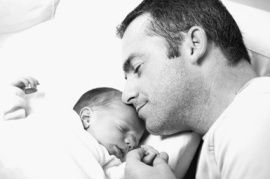
Most newborns will sleep a lot. 17 hours a day is the average. Average
means that there are many babies sleeping much less (down to 11 hours)
or even more (up to 23 hours).
To know
if your newborn
sleeps enough
,
it's much better just to observe her to see if she is content, check
how
much sleep is enough
for detailed guidelines. If you are
unsure or worry,
ask
here
.
Do you have to
put your
newborn down awake
? Learning to self soothe is indeed an
important skill for a baby to learn. Putting her down in her crib awake
is the always heard advice for this. For some newborns, this works;
they
have a natural skill to just lie down and sleep. And that is a
wonderful skill you'll want to keep going.
For
others though, this advice is a joke (it was for me with my babies!).
And at this age, they're too young to be forced (let alone
cry
it out
!). They will easily
rock
or nurse to sleep
,
be held a
bit and then continue to sleep in their crib. Between 4 and 8 months is
when most babies easily do start
self
soothing
. You can then guide them
by gently decreasing the holding, rocking or nursing to sleep.
Use effective
newborn
crying tips
to soothe your tiny baby when she cries.
Newborn Sleeping Must-Haves
Basically, there are only two things you need:
a
safe place to
sleep
and a dimmable
night light
.
Whether
you want
baby sleeping
in her own room or cosleeping
in your room is a very
personal choice. Often also practical matters play a role: do you have
a
separate room available, and do you have space in your bed or next to
your bed for a crib.
And also, when baby is finally there, many parents find themselves
doing the exact opposite of what they had planned, just because it
feels right at that moment.
In the first weeks and months,
having
baby
in your own room
has quite a few
advantages
. It
allows you to respond
quickly to baby's needs; you may find you can often soothe her by
simply reaching out your hand on her belly, long before she cries or
asks for a feeding (a great practice towards self-soothing!).
Breastfeeding moms also find it very comfortable not to
have to get up completely for night feedings.
Whether
co-sleeping or not
, the main thing is to create
a safe sleeping place
. A
safe
sleeping position
(on the back is recommended) and
a
safe crib
are important to avoid injuries and to reduce the
risk of SIDS.
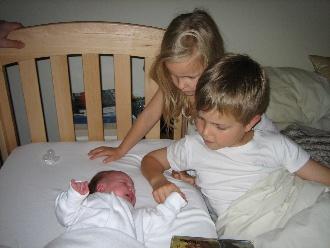
As
an alternative to in-bed
co-sleeping, I
can highly recommend
a cosleeper
.
That is a
side car bed
,
attached to your bedside.
It gives baby
her own crib space, but she is
still near you for feeding, soothing and for you to watch over her.
The other must-have is
a
night light
, preferably one you can dim and brighten as
needed. Light and activity cues help steer your newborn's
sleep
patterns
by teaching her the all-important difference
between day-and-night.
During night awakenings and feedings, the adjustable nightlight helps
you
keep the
lights dim
and still give you enough light to see what you
are doing. As baby grows,
a
dim nightlight will reassure
her and keep her from
being scared in the dark.
More tips to help your newborn sleeping well in
the
sleep
schedule
section.
To find out how to teach your new baby the right sleeping
skills now, when it matters most, you may find my free
Complete
Newborn Sleep Guide
helpful.
Article Author: Heidi Holvoet, PhD - Founder, senior sleep consultant

Heidi Holvoet, PhD, is the founder of the Baby Sleep Advice website and movement, an award-winning author, baby & toddler sleep consultant with 15+ years experience as well as a certified lactation counselor.
Over the years, Heidi has received several awards inluding a Mom's Choice Award (MCA) and National Parenting Awards (NAPPA) for her Baby Sleep Advice website, programs and books. Also, Baby Sleep Advice was awarded "Most Trusted Infant's Sleep Solutions Company 2023" in the Benelux Enterprise Awards 2023.
Heidi continually conducts personal research and participates in continued education and in that way stays up to date with current scientific and pyschosocial infant care.

She is also a member of the Association of Professional Sleep Consultants of which she was one of the earliest contributors. She obtained her PhD degree in physics at the University of Ghent in Belgium.
Heidi is passionate about helping babies and their parents sleep more and better, with her trademark approach that has been proven and praised time and again by parents worldwide to be effective and truly no-tears. Respect for you as a parent and your baby, is at the heart of Heidi's warm and kind support. Her approach always keeps in mind a baby's needs and abilities at any given age, is based on pediatric science and the most up to date knowledge in infant care and sleep science.
As well as the award-winning baby sleep programs, Heidi offers popular 1:1 consults and easy-access 30-minute SOS Sleep sessions.

Baby waking every hour?
by Heidi Holvoet, PhD

Sleep schedules by age
by Heidi Holvoet, PhD

Separation Anxiety
by Heidi Holvoet, PhD
Crib safety guidelines
by Heidi Holvoet, PhD

Why does my baby wake up every hour?
by Heidi Holvoet, PhD