
Crib safety guidelines
Author Name: Heidi Holvoet, PhD
Medical fact-check: Dr Leah Alexander, M.D., F.A.A.P.
Crib safety is your number one priority when putting your baby to sleep. Follow all guidelines below to protect your child from SIDS and prevent injuries.

A safe sleeping place automatically makes your little one
feel
protected
and secure.
And at any age, it is when we feel safe and secure,
that we can relax en are able to sleep
well.
So
a safe crib also
helps your baby sleep better
. And knowing that your child
is safe, you'll feel and sleep better too of course.
Note:
All guidelines on these pages
are based on international health and safety regulations from reports
by governments, health and sleep research associations.
Crib safety guidelines
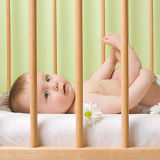
An under one year old should sleep in a crib (or cot, or baby bed)
that leaves no risk for her to get stuck with any part of her body.
Making your baby's bed safe is an important
SIDS prevention
task.
With "bed" here we refer to any baby size bed, usually wood, with a frame
(made up by the slats) around it to ensure baby cannot roll or fall
out.
Some cribs have adjustable mattress heights. These can be used during
the first months when there is no risk yet of climbing out. With
the mattress higher up you don't have to reach so deep to put
your little one in or take her out.
A safe bed
will have the following characteristics:
- The bed is in a perfect condition and correctly assembled. No loose or broken parts.
- Bed slats high enough or the crib mattress deep enough to prevent baby from rolling out, or an older baby from climbing out.
- A distance between the slats from 4,5 cm (1 3/4 inches) to 6,5 cm (2 3/8 inches).
- A firm and tight-fitting mattress so that baby cannot get stuck between the mattress and bedside or slats.
- No toys, pillows, quilts, stuffed animals, strings, ... in the bed. In short: a safe bed holds the baby and nothing but the baby .
- Crib bumpers (often used to decorate and soften the sides of the bed) are not OK to use as they are deemed unsafe, even for babies who are not mobile yet, as per these AAP recommendations .
- A mobile is OK as long as it cannot be reached and pulled into the bed. It should be removed from above the crib once your baby can sit up alone
- Make sure no small parts like screws or protection pads can come loose or stick out.
- Crib material and all paint used should be safe; verify this with the manufacturer's specifications. Also think of safe crib rails with plastic top covers for during teething.
Crib safety questions
Is a travel crib safe?
A folding
travel crib
can be
used but is really only recommended when the real crib is not at hand, e.g.
when traveling or sleeping over at family or friends.
Most of all the travel crib must be in an excellent condition, be set up
correctly, have sturdy sides, have a firm and tight-fitting mattress and no gaps between mattress and crib ... and have nothing
but the baby in it.
When can I use a small pillow in the crib?
Never use a
pillow under two years old.
The head can sink in the pillow and that prevent good breathing.
A pillow will also heat up your child which can be dangerous as well.
Can I use a duvet, blanket or quilt as a cover?
Duvets and
warm covers will heat up your baby too much which increases the risk of
SIDS.
It is better to use a layer, or several layers, of light
blankets/sheets. Remember to place the feet at the foot end of
the bed so she can not slide downwards and under the covers.
Better still is a well-fitting
baby
sleeping bag or wearable blanket
. It will keep baby
covered without overheating (choose a light one) and without the risk
of covering her head.
Make sure the sleeping bag is the right size so your child cannot slip down
into it.
Combine these crib safety guidelines with the guidelines to
prevent
SIDS
for optimum security.
Article Author: Heidi Holvoet, PhD - Founder, senior sleep consultant
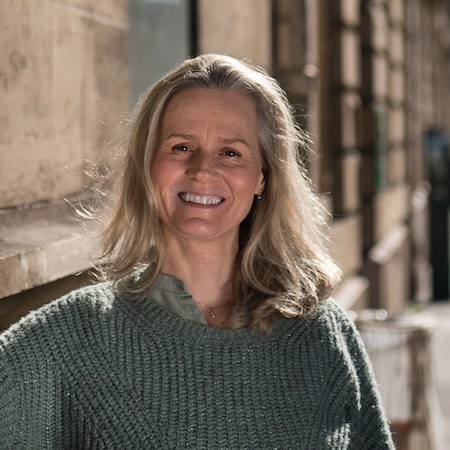
Heidi Holvoet, PhD, is the founder of the Baby Sleep Advice website and movement, an award-winning author, baby & toddler sleep consultant with 17+ years experience as well as a certified lactation counselor.
Over the years, Heidi has received several awards inluding a Mom's Choice Award (MCA) and National Parenting Awards (NAPPA) for her Baby Sleep Advice website, programs and books. Also, Baby Sleep Advice was awarded "Most Trusted Infant's Sleep Solutions Company 2023" in the Benelux Enterprise Awards 2023.
Heidi continually conducts personal research and participates in continued education and in that way stays up to date with current scientific and pyschosocial infant care.

She is also a member of the Association of Professional Sleep Consultants of which she was one of the earliest contributors. She obtained her PhD degree in physics at the University of Ghent in Belgium.
Heidi is passionate about helping babies and their parents sleep more and better, with her trademark holistic and truly-no-tears approach that has been proven and praised time and again by parents worldwide to be effective and truly no-tears. Respect for you as a parent and your baby, is at the heart of Heidi's warm and kind support. Her approach always keeps in mind a baby's needs and abilities at any given age, is based on pediatric science and the most up to date knowledge in infant care and sleep science.
As well as the award-winning baby sleep programs, Heidi offers popular 1:1 consults and easy-access 30-minute SOS Sleep sessions.
Baby waking every hour?
by Heidi Holvoet, PhD

Sleep schedules by age
by Heidi Holvoet, PhD
Separation Anxiety
by Heidi Holvoet, PhD
Crib safety guidelines
by Heidi Holvoet, PhD

Why does my baby wake up every hour?
by Heidi Holvoet, PhD
'%3e%3cg id='Final-Copy-2_2_' transform='translate(1275.000000, 200.000000)'%3e%3cpath class='st0' d='M7.4,12.8h6.8l3.1-11.6H7.4C4.2,1.2,1.6,3.8,1.6,7S4.2,12.8,7.4,12.8z'/%3e%3c/g%3e%3c/g%3e%3c/g%3e%3cg id='final---dec.11-2020'%3e%3cg id='_x30_208-our-toggle' transform='translate(-1275.000000, -200.000000)'%3e%3cg id='Final-Copy-2' transform='translate(1275.000000, 200.000000)'%3e%3cpath class='st1' d='M22.6,0H7.4c-3.9,0-7,3.1-7,7s3.1,7,7,7h15.2c3.9,0,7-3.1,7-7S26.4,0,22.6,0z M1.6,7c0-3.2,2.6-5.8,5.8-5.8 h9.9l-3.1,11.6H7.4C4.2,12.8,1.6,10.2,1.6,7z'/%3e%3cpath id='x' class='st2' d='M24.6,4c0.2,0.2,0.2,0.6,0,0.8l0,0L22.5,7l2.2,2.2c0.2,0.2,0.2,0.6,0,0.8c-0.2,0.2-0.6,0.2-0.8,0 l0,0l-2.2-2.2L19.5,10c-0.2,0.2-0.6,0.2-0.8,0c-0.2-0.2-0.2-0.6,0-0.8l0,0L20.8,7l-2.2-2.2c-0.2-0.2-0.2-0.6,0-0.8 c0.2-0.2,0.6-0.2,0.8,0l0,0l2.2,2.2L23.8,4C24,3.8,24.4,3.8,24.6,4z'/%3e%3cpath id='y' class='st3' d='M12.7,4.1c0.2,0.2,0.3,0.6,0.1,0.8l0,0L8.6,9.8C8.5,9.9,8.4,10,8.3,10c-0.2,0.1-0.5,0.1-0.7-0.1l0,0 L5.4,7.7c-0.2-0.2-0.2-0.6,0-0.8c0.2-0.2,0.6-0.2,0.8,0l0,0L8,8.6l3.8-4.5C12,3.9,12.4,3.9,12.7,4.1z'/%3e%3c/g%3e%3c/g%3e%3c/g%3e%3c/g%3e%3c/svg%3e) Your Privacy Choices
Your Privacy Choices